






 Your shopping cart is empty!
Features of religion in Thailand. How to accept Buddhism in Pattaya?
Religion in Thailand has a special status and the attitude of local residents towards it is significantly different from the usual. If in Russia not all are believers and most people visit temples only on holidays, then in Thailand faith is tightly intertwined with everyday life. Such a thing as an atheist is practically not found here, and kindness characteristic of Thais, calm and constant smile - all these are manifestations of Buddhism.
Features of religion in Thailand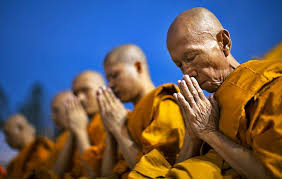
More than 95% of the inhabitants profess Thai Buddhism, or rather the oldest branch of Buddhism - the sense of Theravada. There are also later branches of Buddhism, which are based on additions to the teachings of the Buddha from his followers and are successfully practiced in other countries. Buddhism in Thailand is based on the law of karma, according to which everything that happens to us is the consequences of our past actions. Here are a few more main aspects of this religion:
Thais believe in the relocation of souls, and our body is just a transient form.
Our life consists of suffering, which are a consequence of our desires.
The meaning of the life of the Buddhist in achieving bliss without any desires is nirvana.
Different directions of Buddhism are also characterized by a different perception of the Buddha. Buddhism in Thailand perceives Buddha as an ordinary person who has reached enlightenment, and not at all as a deity. Therefore, Thais do not worship Buddha and do not ask him for forgiveness or blessing, but follow his teachings and revere him as teachers. Thais believe that the responsibility for our life and our happiness is only in our hands, and not in the hands of God.
In the life of ordinary residents of Thailand, religion has made several important rules:
People should strive for a happy life and help others in order to achieve enlightenment.
You need to do good deeds to improve your karma.
All manifestations of violence and the consumption of intelligence substances are strictly prohibited.
It is noteworthy that in Buddhism there is no direct imposition of exercises and religion, everyone can decide their own fate. If in this and next life a person wants to be happy and successful, he must do good deeds, help those in need, visit the temple every week and provide support to the monks. In the opposite case, if you cause suffering and pain to other people, you need to be prepared for troubles and misfortunes in this and the following lives. With his negative actions, a person spoils herself karma.
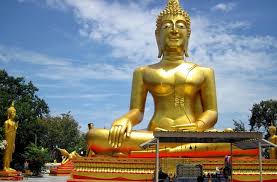
Visiting temples
As you could understand, Thais treat Buddha not as a deity and a creature from above, but as a teacher who shares his teachings with them. Therefore, Thais visit temples not in order to ask for mercy or complain, but to express their respect to the teacher.
Participation in religious ceremonies and observing traditions are considered very good actions that improve karma. During a visit to the temple, everyone should make three bow as a sign of respect and light three candles, since the symbolic number three denotes the Buddha, his teachings and followers.
Despite the fact that almost everyone professes Buddhism, Thais are very tolerant and respectful of other religions. There is even a law in the country according to which the king must follow the teachings of the Buddha and act as a defender of all religions and believers. So other religions in the kingdom have the same rights as Buddhism.
How to accept Buddhism in Thailand?
Anyone who, being in Pattaya or another city of the kingdom, was imbued with Buddha’s exercises and would like to accept Buddhism, can go through a simple procedure for taking refuge. With this ritual, you show your readiness to follow the teachings of the Buddha and respect him as a teacher. This does not oblige you to abandon other religions and follow only one teaching, Buddhism always leaves the right to choose you. Without even making any rituals, you can observe Buddha’s teachings simply at your request or because you are close to these laws and you like to follow them. Buddhism is rather a way of life, and not just faith.
In any case, going to Pattaya or some city abroad, each tourist should familiarize yourself with at least the basics of the local religion and respect it. And to strive for nirvana and enlightenment or just to live your life happily, making others happy - this is only your choice.
Thai Buddhism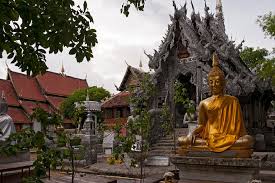
The Buddhism of the tradition of the Theravada (Theravat) is traditional for Thailand, this tradition is professed by 95% of the inhabitants of the kingdom. This branch is otherwise called Hinayna or a small chariot, unlike a large chariot, Mahayana, common in Tibet, China, Mongolia, Buryatia, Korea and partially in Japan, merging with the local traditions of synthoidism. Khinayan is also called Buddhism in its pure form in which Buddha Gautama gave it. The large chariot, Mahayana, got its name due to the significant additions of the teachings of the followers of the Buddha and differ primarily the attitude to the personality of the Buddha. In Mahayan, the Buddha is considered God with all the ensuing consequences. Mahayana texts are recorded in Sanskrit, but Tibetan dialects can be used in practice.
In addition to Thailand, Hinayana also received spread on Sri Lanka, in Myanmar (Burma), Cambodia and Laos and is considered the teachings of the Buddha in the original form, where the Pali canon is used. It was this canon that had a huge impact on the Thai language and the formation of the alphabet, with the help of which all Pali texts are now being recorded. And although Buddhist vocabulary is not the main Thais in everyday life, almost everyone has known it from early childhood.
Buddhism in Thailand can not be called religion in the sense that we are used to understanding this. There is no concept of God in Theravad, there is no concept of faith, as in Christianity, so its religion can only be considered conditionally. Gautama Buddha was a teacher, a man, and not a god who gave people knowledge how to get rid of suffering, awaken, know the essence of things and gain true bliss in a nirvana.
Those Buddhist rituals that we see in Thailand have nothing to do with prayer. Buddha cannot be asked about the miracle, that he makes life better, give health. We see only a tribute to the greatest person, not a prayer. Buddha gave his teaching in order for everyone to make his life better, and asking him about more simply inappropriate and pointless.
The basis of the teaching is the concept of karma (Kaan Brumha - Book), which consists of Bun (Kuson, Bun Kuson), merits, a good deed, and Baap, a bad act. The concept of sin in the Christian understanding is absent. According to the canon, everyone must choose what to do, how to sculpt his karma, do good or evil, and not ask someone to make good karma in absentia. He did a good deed - got a plus to his karma, made a bad act - get a minus. Those. The banana will not grow from the burdock of the burdock. The accumulation of merits and the filling of your karma is the meaning of Buddhist's lives. After death, the Spirit (Thyvada) falls into the Savannah (Savan), on the intermediate “heaven”, or to the sedimentation carrier (uku), where life lives and after death “in the next world” is reborn on Earth. That is, who has karma positive, reborn people with a status dependent on the accumulated merits. Otherwise, you can degenerate by an animal or tree, for example. So, killing a mosquito, think about who the next life will have to live. ;)
Thais believe that positive karma works not only for the next lives in the savannah or on Earth, but also makes life better right now. And if life does not improve, then you need to do more good deeds. There is a reverse situation. For example, someone does a bad deed, and it gets away with him. This is explained by the existing good karma with a bunch of previous merits. But here it is worth knowing that any minus sooner or later will make itself felt, and then you will have to strain hard to straighten karma.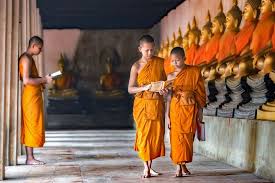
There is no sufficient amount of good deeds during life. If the cup of karma is filled with a mound under the tie, a person reaches awakening and goes to Nirvana forever. But if a person is still here, this means that there are flaws. And there is no need to ask for anything to ask for a Buddha, everyone should only work on himself.
Along with canonical Buddhism in Thailand, there are two Teravada faiths: Mahanikay and Thammayutikay, founded by Prince Mongkut before he became the king of Rama IV. The principles of Theravada are preserved here, the differences are minimal.
The old Proobuddian traditions of the Thais have survived to this day. They were closely connected with Buddhism, in the process of integration there were no problems, obviously, due to the loyalty of the principles of Buddha’s teaching: rejection of violence, restraint, balance, and a different view of problems in the world. The manifestations of these old traditions can be easily seen in everyday life. These are small houses for the spirits of Khanphrambhum, food for spirits, various amulets. Today, you can often see on men large breast amulets of the round shape made of gold (Tatukham Ramtheip). As a rule, these are very expensive accessories, their price can reach a million baht. It is believed that the guardian angel (Sing Saxit), living in this amulet, will protect its owner, attract good luck, protect health, etc. Depending on the type of amulet. These amulets have exactly nothing to do with Buddhism.